
Watching Paint Dry
and other pastimes of an analog artist

I resisted the whole cell phone/computer thing as long as I could. I didn’t get an email account till around 2004 or 5, my first hand me down computer in 2005. I upgraded to an iMac in 2006 (which is still in service as my offline studio computer on which I view photos of images I paint from). I didn’t get a cell phone until 2007, after my disastrous December 2006 meeting of an icy road, an unseen ditch in the snow and my ankle. I didn’t have the internet at my house until 2011, but I checked my email once or twice a week at the library whether I needed to or not.
I have a more modern, powerful iMac now, and more digital devices than I am willing to acknowledge. I don’t have the most up to date iPhone, but it’s newer than my first hand me down iPhone 4. Internet at the house, which might have been a mistake.
But the one completely luddite thing I refuse to give up on is painting with actual paint.
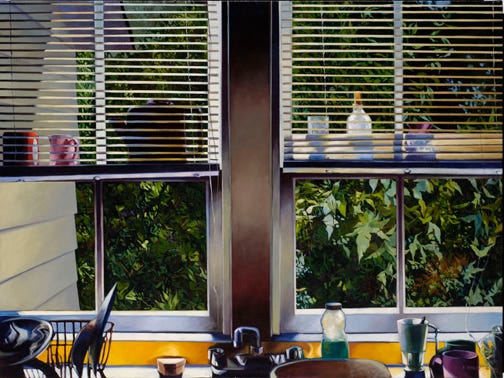
In my Element
2007 Oil on Panel
36”x48”
Can we talk for just a minute about what we call things?
I went to art school in the early to mid 70’s and early 80’s in the previous millennium. We called a watercolor a watercolor. We called an oil painting an oil painting. If you made it with a brush it was a painting and if you drew it with charcoal or a pencil it was a drawing. If you photographed it with a camera it was a photograph.
I know photographers that are very careful to differentiate pictures taken with a film camera and developed, and printed in a dark room (which is a SKILL, people) and a digital photograph. Both can be beautiful, and both can be art, but they are not the same thing. In my mind, film photography, being the ancestor of digital photography, deserves the earlier, simpler designation of “photography” while digital photography, being the descendent of film, as well as earlier forms of photography, can just get along with being called “digital photography.”
Why yes, you could call me pedantic.
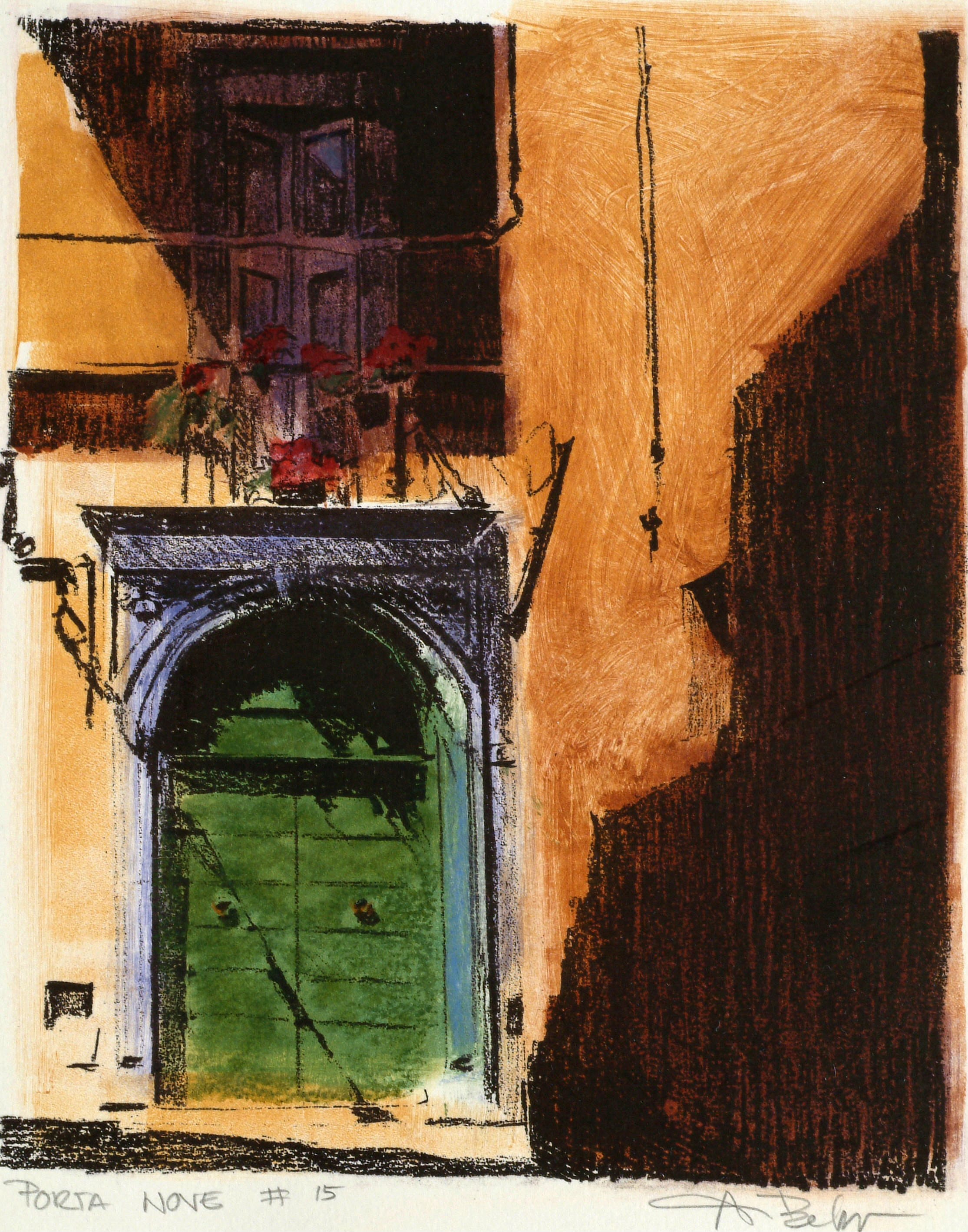
Porta Nove
Monoprint/lithograph
9” x 7”
You might see where I’m going with this diatribe…
I recently got into a “discussion” with someone who called a digital artwork an “oil painting” (quotation marks theirs). I took exception to this because…well, yes I am pedantic… I am willing to recognize that a digital art work can be beautiful and skillfully done, it is not, in fact a “painting” (with or without quotation marks)
I went to art school at a time when the painters were all pretty full of themselves. I admit to this. It was also a time when painting styles were all over the place. There were people saying painting was dead. There were people making big, contemporary abstract paintings, and my cohort of sincere (and pedantic) representational painters. I spent a semester in the Delaware Water Gap National Park learning to paint en plain air from life. In fact, I never even painted from a photograph from the time I started my art education in the 60’s until the late 1980’s when the reality of painting extensively from my travels meant I had to start working from photographs I took when I started traveling to far away places, if I wanted to do more than small, on site paintings.
So, meanwhile, this discussion went around and around, with this person not grasping why I thought what they were doing might be art, but it was most definitely not a painting.
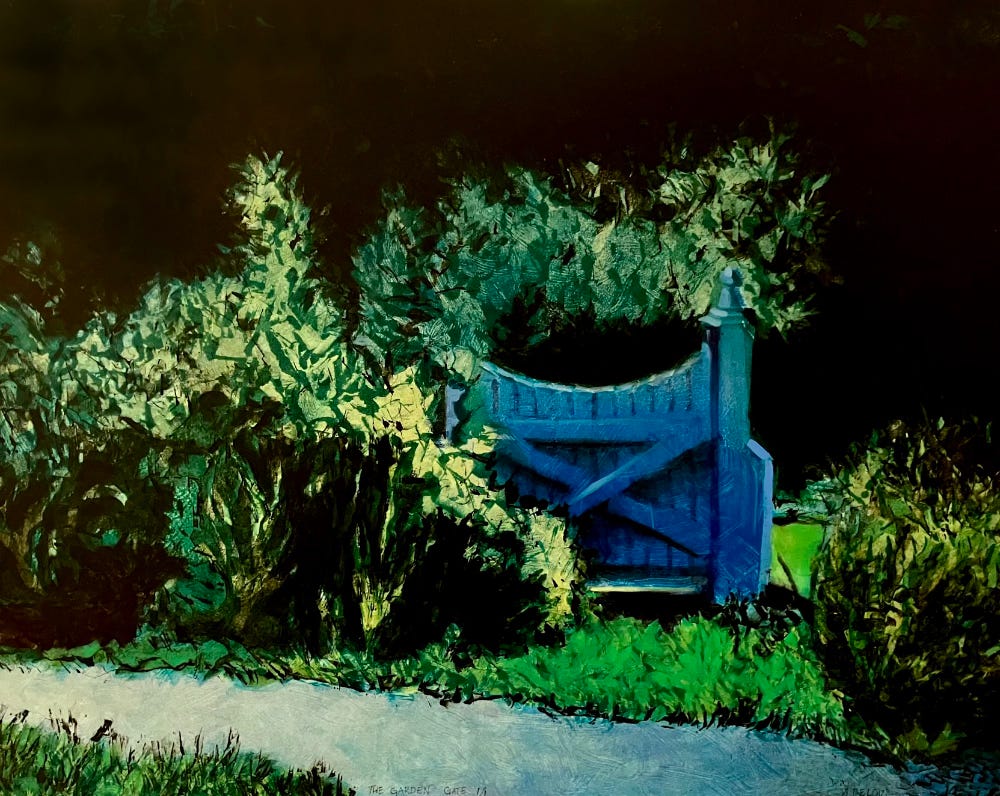
Island Gate
Monotype/mixed media
16” x 20”
And Now Printmaking Enters the Chat…
Yet another aspect to my life as a luddite, I started doing printmaking seriously in the mid 1990’s, first with the opportunity to make several editions of lithographs at Stone Press studio with the late, accomplished painter and printmaker, Kent Lovelace. After my taste of making prints as an artwork, I looked for other opportunities and found Island International Artists up on Guemes Island. After a few years there learning how to make traditional etchings, and after I built my house with the studio with space for my own etching press, I got my own press so I could expand to other forms of printmaking. I started experimenting with monotype and polymer plate lithography.
Through the late 90’s and well into the 00's a good portion of my income came from printmaking. But along with the housing crisis and resulting recession, which crashed the art market in general, digital reproductions started making serious inroads into the printmaking sales market. While I accept that digital reproductions are now a fact of life, I deeply resent muddying the water by calling them “prints” while in reality they are reproductions of existing artworks.
When I cleared the crap off my press to reactivate the printmaking part of my practice, I realized what a sizable investment I had made over the last 3 decades. Not only the press, but ink, paper, support furniture, blotters, and tools, not to mention the years it has taken me to learn and refine the skills in making prints.
I’m not saying reproductions and art with purely digital origins can’t be beautiful and fill a need in the desire to fill our homes with images that makes us happy. They can be a satisfying way of making art. But they are not “paintings.” They are not “prints”
Working with ink and paint, canvas and paper, brushes and brayers, is intensely visceral and satisfying in a way diddling a stylus on an iPad will never be.
I will die on this hill.
Whether you create paintings that are gallery worthy fine art, or you move paint on a canvas in search of your own deeper truth, or draw in a sketch book to better remember a place you have been, what you are doing is intensely profound. Physically putting pencil to paper accesses memory deep in your body. (Lynda Barry says so and she is a MacArthur certified genius). To appropriate the names of these processes cheapens it all.
I have dedicated and spent my life in the pursuit of making art.
And I’m going to call it what it is and how I see it.
I’m sure I’ve stepped on a few toes here. Sorry if they were yours. 🙄
I haven’t even addressed the whole AI thing, but you can probably tell I am against it. I’ll probably rant about that some other time!
Sing it loud sister!!!! I'm singing alongside you and dying on that same hill!!!! I didn’t get a digital camera until 2009 or so. A laptop in 2015 or so. I didn’t get a smartphone until 2019. Nowadays I've been scaling back the already minimal time I spend with these digital devices. The phone is the hardest to minimize. I've even begun doing my paperwork the galleries require in handwriting. At most taking a photo of my handwritten exhibit statement (for ex). At my exhibit opening last night I explained repeatedly that I made everything by hand using ink, dip pens, fountain pens, btushes, gouache and acrylic paints. For my artist books I take photos of the original handmade artworks for reproduction - and I'd point to the physical art on the wall and then to the same art in a book, or on a card. I'd show how much nuance the original art has compared to the reproduction- tho the reproduction is good quality. I explained that I made reproductions because I'd made a storybook (for ex) or a greeting card which requires a certain form and they're intended to be affordable art so people can share them with other people. Etc. I saw the whole event as one of educating...
Anyway, I'm typing too much and I know you know what I'm talking about. I raise my ink bottle in your honor!
Linda Barry! Thank god someone else knows she’s a genius. :) She got me through childhood and my teen years intact. I absolutely support the drawing of a line between reproductions and original art. Spending a lot of time in various places of the world though, I’ve noticed that there are copies and copies and copies of all kinds of art that we consider significant and unique. How many original Rodin’s Thinker or Michelangelo’s David are there out there? A few! Rodin created molds for his pieces so they could be recasted. Copying a master was part of an apprenticeship during the Renaissance. There are hundreds of Muchas’ prints all over the world because he was a commercial artist, and the number of Dali’s international ad campaigns are hard to count. All this to say that I think it’s fascinating that mass production of art is both extremely problematic for creativity/creatives and an indispensable part of maintaining a creative ecosystem. AI can F all the way off, tho. 😛 Thanks for a fun read! You have new subscriber.